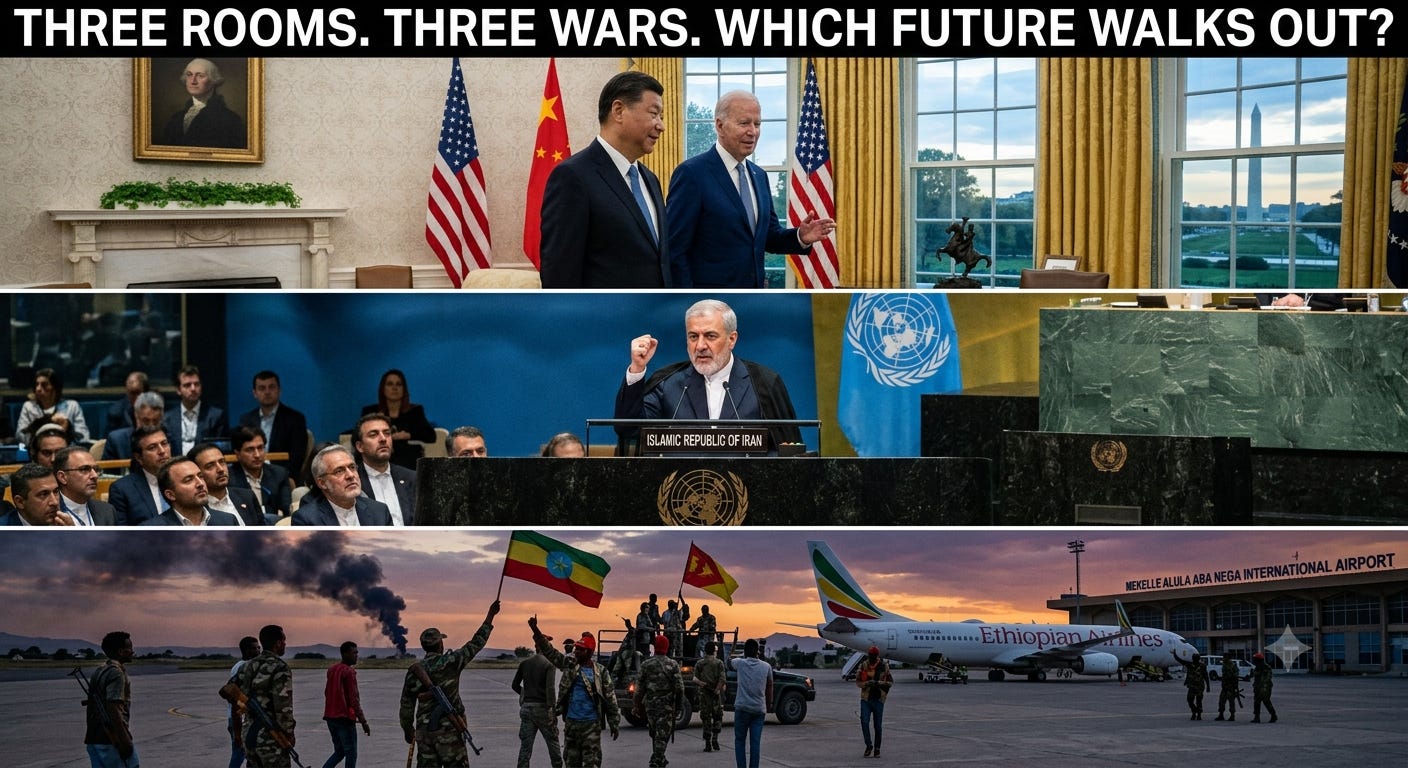
Three rooms. Three wars. Which future walks out?
Listen to this article
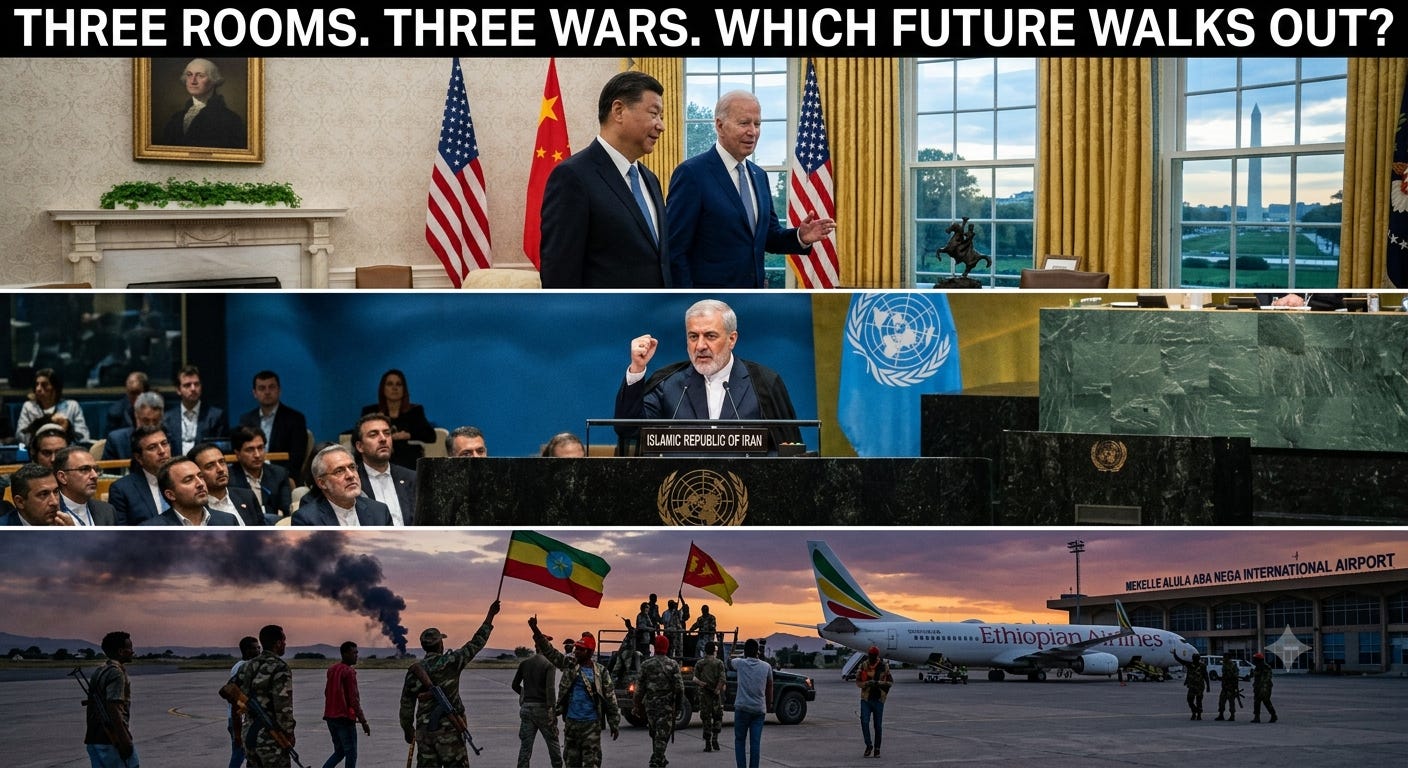
Thursday, 24 September 2026, is not one story. It is three high-leverage events running in parallel: Xi Jinping’s first state visit to Washington in eleven years; a defiant Iranian president at the UN while the Strait of Hormuz remains a contested corridor under U.S. blockade; and the Tigray People’s Liberation Front seizing airports and declaring a “defensive war” against Addis Ababa. Each is a genuine branch point. The probabilities below are rough, signal-weighted estimates—not markets. They will move with the next statement, strike, or handshake.
Event 1: The Trump–Xi White House meeting
Xi landed Wednesday to a rare planeside greeting from Trump. The agenda is packed and contradictory: trade irritants and an extended truce (already stretched toward 10 January), AI “safeguards,” Taiwan arms sales, and whether Beijing will lean on Tehran over Hormuz and oil. Tech CEOs are on the state-dinner list. Direct players: Trump, Xi, Rubio (now dual-hatted as NSA), Treasury, and the two trade/investment boards created after the May Beijing summit. Indirect: Taiwan, Iran, Nvidia and the chip pipeline, soybean and Boeing constituencies, midterm-facing U.S. politics. Backing: both leaders want a “don’t rock the boat” photo more than a breakthrough; markets want the truce to hold; hawks on both sides want the opposite.
Branch 1 — Managed freeze (≈28%)
A joint statement on “constructive strategic stability,” modest extra agricultural and aircraft purchases, vague AI consultation language, and no new Taiwan red line. Hormuz language stays hortatory.
Means: another 4–8 months of predictability. Benefits: farmers, Boeing, chip exporters who already got limited H200 licenses, anyone long risk assets. Does not benefit: Taiwan’s defense planners, rare-earth diversification hawks, or anyone who wanted a decisive Iran off-ramp. Macro: oil stays elevated but not chaotic; 10-year yields stop racing; the midterm calendar stays the dominant U.S. variable.
Branch 2 — Transactional squeeze (≈22%)
Trump extracts a visible China signal on Iran (diplomatic pressure, or at least no new dual-use flow) in exchange for quieter language on Taiwan sales or another chip carve-out.
Means: Washington tries to make Beijing a co-manager of the Gulf. Benefits: U.S. energy consumers and CENTCOM’s escort burden. Does not benefit: Iranian hardliners or Chinese firms that prefer strategic ambiguity. Macro: a modest Hormuz risk premium compression if markets believe it; Taiwan premium stays bid.
Negative branch — Performative rupture (≈9%, rises if either leader needs a domestic win)
A walk-back on the trade truce, public Taiwan language that Beijing treats as casus, or a leak that Xi refused any Iran role. Precursors: a midterm-focused Trump presser, a PLA exercise timed to the visit, or a Hormuz strike the same day.
Means: tariffs snap back, rare-earth and chip tit-for-tat resume, oil and 10-year jump together. Who loses: anyone with a 2027 planning horizon.
Sponsored by ZeroDriveX
Sources:
Reuters: “Trump-Xi summit in Washington begins with great fanfare but low expectations” (Sept 24) — Trump’s welcome remarks, “truly great friendship,” agenda items including security/technology/“super intelligence,” military ceremony, and low expectations for major breakthroughs
https://www.reuters.com/world/china/trump-welcomes-xi-washington-looking-trade-win-2026-09-24/
Reuters: “US says China trade truce extended as Trump welcomes Xi” (Sept 23) — Treasury Secretary Bessent on the truce extension to January 10; arrival details and thorny issues (trade, tech, Taiwan, Iran).